
Concerned UK citizen warns: false black widow spiders are everywhere
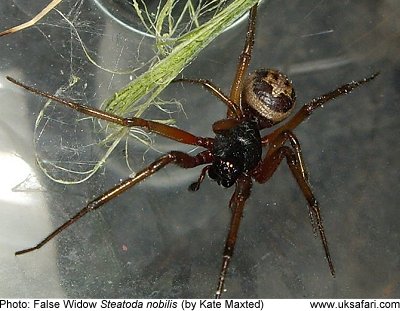
We have just had false black widow spiders confimed in our home but I have also found them in the shed, outbuildings and even polytunnel, a concerned citizen from South Wales, UK, warns her fellow citizens and continues our local authority have said due to climate change they are everywhere now but wont record it due to negative impact on tourism trade.
I have been told to vacuum and be careful of my children getting bitten. I am angry this is being kept quiet as their bite is painful and they jump at you if disturbed which is how I found them!

Steatoda nobilis, commonly known in England as the biting spider or the false widow, is a common species of spider in the genus Steatoda. As one of this spider’s common name indicates, the spider superficially resembles, and is frequently confused for, the black widow and other venomous spiders in the genus Latrodectus. The spider is native to the Canary Islands but arrived in England in around 1870 through bananas sent to Torquay. In England it has a reputation as one of the few local spider species which is capable of inflicting a painful bite to humans – although this is a comparatively rare occurrence.
According to Stuart Hine, an insect expert at the Natural History Museum, the species is spreading rapidly.
The truth is that Steatoda nobilis is increasing its range and it will become more common unless the UK climate reverts again to more severe winters, which doesn’t seem likely.
The facts are that of 640 UK spider species only 12 are recorded as having bitten humans and they tend to be larger species, Tegenaria spp, Amaurobius spp, Nuctenea umbratica, and native Steatoda, S. grossa in particular. Generally speaking the effects of bites/invenonmations are paltry, though shocking for the victim. But of course each individual reacts slightly differently and some more severely. (Naturenet.net)
Spider bite symptoms
The widow neurotoxin, active against vertebrates, opens cation channels (including calcium channels) presynaptically, causing increased release and then depletion of multiple neurotransmitters affecting somatic and autonomic nerves.
Brown house or false widow spiders – Steatoda grossa in Australia and Steatoda nobilis in the UK, have caused mild neurotoxic arachnidism and, in the case of the former, have been treated successfully with redback antivenom.
- The severity of symptoms from any spider bite depends on the amount of venom that is injected.
- False widow spider bite reports include symptoms such as chest pains, swelling and tingling of fingers.
- A bite from the false black widow delivers enough poison to cause severe pain and inflammation.
- Although rare, some people can have serious allergic reaction to the bite and within seconds they could be gasping for breath and losing consciousness.
- A characteristic feature is pain. Initially the bite can go unnoticed or be perceived as a sharp pinprick. The pain can be local or spread proximally from a bite on the limb to the torso, causing chest or abdominal pain.
- Nonspecific systemic features (nausea, vomiting, headache, lethargy, and malaise).
- Local and regional diaphoresis, and less commonly other autonomic and neurological effects.
- The facies latrodectismica from a widow bite is a painful grimace caused by facial spasm and trismus associated with swollen eyelids, congested conjunctivae, flushing and sweating.
- Full latrodectism may also include tachycardia, hypertension, irritability, psychosis, priapism, renal failure, respiratory compromise and cardiac failure.
- If a spider bite is not considered, the diagnosis may be missed, especially in younger patients where communication is limited.
Fear of false black widow spiders
The story of this spider as the UK’s most dangerous spider was first mass publicized in 2006 by Telegraph.co.uk and was republished in 2008 by Dailymail.co.uk. Mr. Hines words as they appear in those articles were debunked in 2007 at Naturenet.net where he apparently wrote reply and stated what he actually said.
…
Through my day job, Manager of Insect Information Service (Natural History Museum) I am aware of about 12 confirmed (we have formally identified the spider) cases of S. nobilis bite in the last 8 years (interestingly we never recorded this species as an enquiry pre 1999, and numbers have risen each year since). I have received two this year already, with accompanying spiders. (one enormous female from the Isle of Wight – that was the gardening glove incident and I never warned gardeners to check their gloves and generally begin to panic). In both cases the ‘victim’ (sounds a bit extreme doesn’t it) described a numbness and pain that radiated from finger tip to shoulder and lasted for several hours. However, I am sure that this is as severe as it would get and many people get bitten and barely notice it.
Of course I also explain the great value of spiders and how rare the event of spider bite in the UK actually is. I also always explain that up to 12 people die from wasp/bee stings in the UK each year and we do not panic so much about wasps and bees – but this never makes it past editing.
Still I could go on, they do bite, people have experienced severe-ish reactions, it is generally nothing to worry about and spiders are of great environmental importance and are really rather beautiful and very interesting.
Nest found in Buckinghamshire garden
TheHuffingtonpost.co.uk reported last month that the nest of this venomous spider has been found in a Buckinghamshire garden. Local pest controllers have dealt with the nest, but council officers warned Bletchley residents that there may be more.
The spiders’ bite is not lethal, but is painful, according to local experts. Liam Mooney from Milton Keynes Council told the BBC: “The spiders have larger fangs than other species and venom behind them. The bite is worse than a wasp sting”.
They are known to live in Britain, unlike the actual black widow species. They tend to live along the coastal areas of southern England and in London. The spiders are related to the black widow, but do not have the distinctive red spot on their backs. They make similar “tangle” webs, which are full of eggs. This means that there are likely to be many spiders in the same small area.
Mothers view on the subject of false black widow bites
Our reader continues with this concerning words:
My view as mother is that being informed is paramount to be prepared. If you know the danger to yourself and your children you can avoid it as best as possible, we must have been living with these for many months completely unaware of the potential danger these spiders represent to us all with young children including 10 week old baby sleeping here its a real worry. What if they were bitten? I would not have attributed it to a spider. Until yesterday I had always taught my children that spiders were harmless and frequently scooped them up in my hand to put outside. We need to know that false widow spiders are here in the UK , in our homes, gardens, workplaces and beyond.
Ways to control spiders in your home and workplace
Outdoors
- Remove or reduce trash and rubbage from your home or workplace (eg. woodpiles, boxes, plywood, tires, empty containers, etc.)
- Keep the outside permimeter of the house free from tall grass, weeds or shrubs especially near the foundation.
- Wear protective clothing including gloves and covered shoes when working outdoors
- Always check items that have been stored in the garage or in a shed or outdoors for spiders, webs or sacks before bringing item indoors.
Indoors
- Keep beds away from the walls
- Don’t store boxes or any items under your bed
- Keep dust ruffles or bed skirts from touching the floor
- Don’t store shoes on the floor or any clothes, towels or other linens (always shake out shoes and clothes before using)
- Store sports equipment like rollerskates, gardening clothes, gloves, ski boots in plastic bags that are tightly sealed with no holes.
- Vacuum under furniture, closets, under heaters, around all baseboards and other areas of the house to eliminate habitat.
- Keep screens on windows and fix or replace screens with holes or that don’t fit snuggly.
- Seal doors with weather stripping and door sweeps
- Seal cracks, access holes for electrical conduits or plumbing
- Remove spider webs and egg sags when found
http://www.nhm.ac.uk/about-us/news/2007/may/news_11767.html
http://www.huffingtonpost.co.uk/2011/10/05/venomous-spider-nest-foun_n_996229.html
http://www.desertusa.com/july97/black_widow_spider_extermination.html
http://www.patient.co.uk/doctor/Spider-Bites.htm

well im shit scared of any spiders and seeing these false widows and reading about them dont help at all and to top all that i think my house is infested in the horrible horrible thing i managed to capture 4 in glasses held them hostage for a day in my living room so i could keep an eye on them and was watching family guy and boom saw one one of the buggers hanging down from the ceiling coming for me to rescue the hostages i ant gonna lie i s$%t myself but caught it and now them four little horrible creatures are out my house thing is now i know there are thousands still in my house and i tell yall now every spider i see is getting killed im ared and ready for them
I have found 2 by my front door what should I do I have the young kids the youngest 7 months and my partner is pregnant please help as I am worried for the safety of the kids and the unborns
We have false widows on the west coast of canada too. I got bit by a baby one that was inside my shirt. I had picked up the shirt from the ground thinking it wasn't too dirty to wear, never thought to check it for a spider. The spider I found was so tiny anyway, I only found it upon inspecting the folds of the shirt around where I was bitten on the back of my upper arm. Glad it was a tiny spider as the bite was quite uncomfortable, caused a small black spot to appear. The only thing that helped the burning itch was peroxide, and a paste of baking soda (separate applications).
There are other types of spiders that bite too. Some have worse bites than others. Some people react worse too.
Generally if I find a spider in my home that looks like a false widow I kill them, but I don't bother with any outdoors. False widows kill wasps, so they aren't all bad to have around. They are only bad if they find way into your clothes or gloves or something. They are part of life.
I used to be terrified of getting spider bites, but now I've had a couple and I know it won't kill me. As long as it's not a black widow anyway 🙂
My sister has been picking up spiders with her hands since we were kids and she has only been bitten once by one of those giant brown monster things. I woke up with a dead spider in my bed and 3 itchy bites on my ankle but I scrubbed my leg with hibbiscrub and hot water they didnt bother me again.My bed is against the wall, under an open window with boxes under it and a valance touching the floor So maybe one spider in my bed in 14 years isnt too bad.
What a load of rubbish. Found many of these in our house over time, never been bitten, removed them without any hassle, kids in house, dog in house, none ever bothered, kids had bee stings that were much worse. When I read the article I couldn't believe it was the same spiders I had seen all the time in the shed and bathroom, never had any worries. As for moving furniture, this is just making people panic for silly reasons. Besides, why kill what hasn't been provoked?
Absolutely right. The 'how to control spiders; above is really annoying to me. It is a liscence to people to create a sterile willdlife-free environment All press reports of 'deadly spiders' in Britain are sensationalist and utter rubbish! Spiders are incredible cratures, worthy of respect and wonder, not of disgust and fear.
I have a False Widdow living under my guttering. I have been watcing her each night and seen what I believed to be her mate strumming on her web and doing a dance with her. I am scared of spiders but think they are beautiful and do iterest me, so have been taking photos. After all this reseach I am a bit worried that it might jump on me and bite. Also, after seeing the 'dance' I think there may be some spiderlings on the way. I don'tknow what to do a I love nature and am a bit of a conservationist and don't like killing living things. These opposing views are confusing me, I have to say that the articles I've read are from The Sun and so I have taken them with a pinch of salt but am now a little wary. Opinions welcome…thanks
What do you do if you capture one? My dad found was in his room last night and has managed to capture, should we kill it or let it go?
Let it go 🙂
ive seen about 20 in my house in the past 2 weeks, im sure i have an infestation here, my neighbours house is empty and abandoned all it has is a load on junk hes dumped in there so im guessing there coming from there, the biggest one i found was in my 3 year old Daughters bedroom it was about the size of my thumb, inc legs, with a big round body, ive killed all the ones ive seen, and today again, my girlfriend found two in the kitchen and one jumped on my Daughter in her bed today.. she was itching her leg and shaking, she said it didnt bite her but there is a tiny pin prick in her thigh.. do u think it could of bitten her or would there be two pin pricks? this was about an hour ago do u think she would of had a reaction by now? im calling environmental health tomorrow as i also have a 6 month old Daughter and i am not risking my Daughters getting bit, to me they are dangerous depending on age and health, but if it was to bite a baby/small child im sure the reactions are going to be worse than if it had bitten a fit healthy adult.
from the UK also, South Wales.
I have a bite. Right now. It’s sort of like being stung by a stinging nettle. Is it one of these spiders? I don’t know. What I do know is this:
I was sitting in a chair and had a ‘money spider’ on me. then another, then another… Then I thought ‘maybe these are baby spiders?’ so I got up, a couple of minutes (no longer) later, I noticed a sore reddish patch on my forearm where one of the little ones had been (they were a sort of olive/khaki colour and very translucent, a few mm long). On inspection there is a nest of spider in the button holes of the chair upholstery. Along with whom I can only assume is mummy spider. Her body is about 1cm long, she is just off black (slighty reddish brown) and has a light band across the front of her abdomen and some very hard to see pale markings on the bulge of her abdomen.
I wonder if she’s a young mother herself.
Either way, she’s going out the kitchen window. And my arm hurts.
– a semi-reformed spider-phobe –
btw – I’m in Bristol, UK.
I was bitten by one of these while in my garden in London. I accidentally put my hand into it’s web! Within 30 seconds of being bitten I started to get pins and needles which eventually went all the way up my arm which stopped at my shoulder. It became quite painful (less than a wasp sting) and burnt/itched a lot. I applied Benadryl cream and went to bed.
Next day my hand had a large swelling – about 7 cm around the bite – and the burning pain remained as intense as the previous day. It was also throbbing. Went to pharmacist who gave me antihistamines, applied ice and kept the hand raised.
Then the next day, my hand looked like a ham-hock with the swelling hiding the definition of my knuckles and wrist-bones. I couldn’t even make a fist and my hand felt like it was filled with burning lead. Went to A and E and (after a 3.5 hour wait) was told that it was infected. Got given antibiotics ‘Flucloxacillin 500mg’ and within 36 hours my hand has, almost, returned to normal. BEWARE – IVE NEVER BEEN SCARED OF SPIDERS UNTIL NOW. Since this I’ve had a look in my garden and seen several false widows!!
i have been doing some building work in north yorks, i noticed spiders at the time but had no fear they could be harmfull , brushing them aside with the dust and rubble etc,
when i returned home i had 2 puncture wounds that were ouzzing and itchy i thought it was a sting/bite. the following morning my full hand has swollen and very itchy i can possibly say by the pics seen on internet and symtoms i beleive i have been bitten by a false widow. i have used cream and ice to releif the itching
Pretty sure I killed on of these buggers on my back patio the other day. We have lots of male and female widows and thought this white abdomened spider to be an immature male. Well, he’s dead. I’m in Colorado Springs, Colorado, USA. Looks like the UK’s not alone.
I have found a false black widow in the house and need advice as to what to do. Should I report it and if so to who?
hi there Andrea dont pick it up try to put it in a dustpan and put it out side your front door and dont let your kids pick it up as it will bite you can call the wild life trust near you for advice hope this helps you.
is an urban ledgend. I klleid it with an OE-254 antenna pole there was no way I would be able function knowing that, that spider was crawling around my site!My theory is (and I am in no way a zoologist) the reason you do not see the really big ones near the kabals is because we have disturbed their natural habitat. The things they like to eat like other bugs, lizards, mice etc went away because we disturbed then too. SO like any creature it is going to go where it can find the most food, and the least competition for that food. So I do believe that the famous camel spider picture of the two spiders together is in fact legit. If you look at the button indentation on the cuffed sleeve you can guage the size as those buttons on those uniforms are 3/4 of an inch long. There is no way that even if they had the spiders really close to the camera and then zoomed in, that those spiders are only a few inches long. The ones I saw in the deserts of kuwait were different sizes large and small so I just wish that people would stop trying to discredit another persons experience.I have seen them run fast ( I did not have a speed gun so I do not a mph speed) fast enough to be very hard to catch. I saw a large one about 5 inches jump up about 2 feet in the air trying to catch a large moth. I tried to kill a smaller one in my tent on my first trip tp kuwait with a 2 4 and after htree good hit it STILL was not dead and while i am engaging the camel spider it rared up its long front feelers and made a hissing sound. I have seen the swollen discolored bite on the leg of my corporal when he was bit by a very small one. I have seen all of the camel spiders that I wish to see and I KNOW FOR A FACT that they are aggressive creatures not because of some monster movie type mythology but because EVERYTHING that I saw in the that desert was aggressive because the desert is a harsh place and aggressiveness = survival.Renee BiswellFormerly Sergeant Houston
i have just found what i think to be a black widow in my shed at the bottom of aload of boxes i have it in a jar now but dont know what to do i have phoned a few places but with no help please help.
Did you get rid of it? Why don’t you go far from home and set if free 😉
i am taking it to the national history museum in the morning they will no what to do or take it to the rspca.
These spiders are really nothing to worry about! These spiders have been in the UK for many years and hasn’t killed tourism yet!
I’ve just found a nest in my garage, in the UK (along with the specimens of the Rabbit Hutch Spider which can also bite) and I’m not overly concerned. They’ve obvious been in there a while and haven’t eaten any of my family (two young children) just yet lol
Seriously, if your reaction to these particular spiders and the associated stories isn’t ‘meh’ then you are overreacting!
well i have them in my shed they r great to have keeps the bloody pests away u dont like the stories people put up about theses spiders r stupid just leave them alone they want kill you.
Having just seen an article yesterday about a man collapsing in a Toys-R-Us store after previously being bitten ten times by one of these spiders, I reckon they could be very dangerous to certain people, depending on their age or health.
My husband and I are based in Fort Irwin,CA and have seen a total of at least 5 of these guys. The first one we kleild in the house was probably about the size of a half dollar, including it’s legs. We have seen and kleild two others inside our house, one being a little larger than the first and the other about the same size as the first. My husband got a picture of one on his cell phone that was in our bathroom. Him and another guy in his troop just saw and kleild one today at the shopette, somewhere outside near the bushes.The largest I have seen, unfortunately, I didn’t take the opportunity to get a picture of. I was letting the dogs out into our yard sometime after midnight, my husband was working a midnight-noon shift, and my bigger dog saw something on the side of our house and chased it up the wall all I saw was a caramel brown set of legs and a long body this was the first one I had ever seen it was about the size of my hand, including it’s legs.let’s just say I got the dogs in, closed and locked the door and was somewhat paranoid for days after. I am deathly afraid of spiders so just imagine how horrified I was to see something like that,I didn’t want to leave the house, until we saw them inside, and then I knew I had to cope with the fact they were everywhere here