
Magnitude 6.2 earthquake struck offshore BioBio, Chile
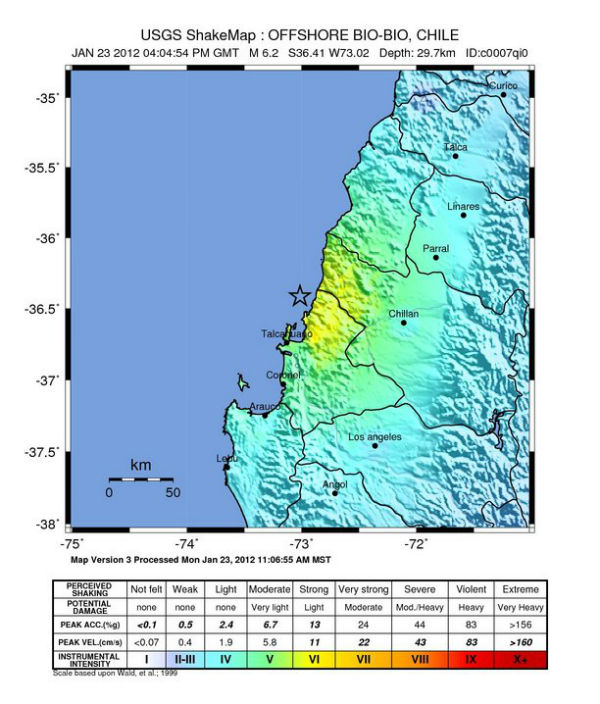
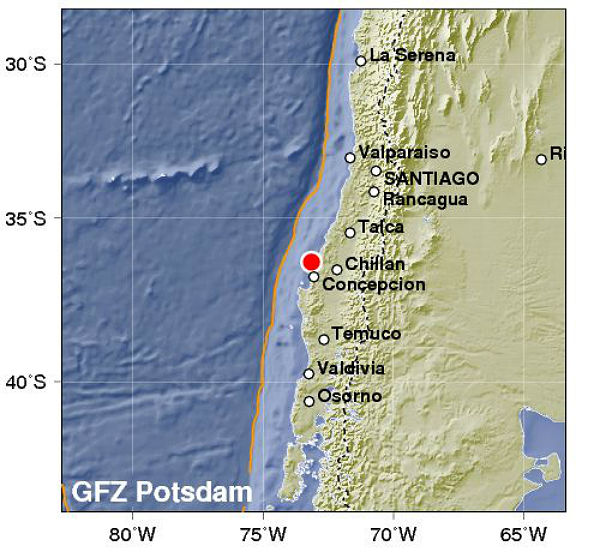
Strong earthquake magnitude 6.2 struck offshore BioBio, Chile on January 23 at 16:04:54 UTC. Epicenter was located  50 km (31 miles) north of Concepcion, 80 km (49 miles) southwest of Cauquenes, 90 km (55 miles) northwest of Chillan and 393 km (244 miles) southwest of Santiago, Region Metropolitana, Chile (36.415°S, 73.015°W). According to USGS the depth was 29.7 km (18.5 miles). GEOFON meassured magnitude 6.1 at depth of 26km (16.1 miles). EMSC registered magnitude 5.8 at depth of 10km...

Strong earthquake magnitude 6.2 struck offshore BioBio, Chile on January 23 at 16:04:54 UTC. Epicenter was located  50 km (31 miles) north of Concepcion, 80 km (49 miles) southwest of Cauquenes, 90 km (55 miles) northwest of Chillan and 393 km (244 miles) southwest of Santiago, Region Metropolitana, Chile (36.415°S, 73.015°W). According to USGS the depth was 29.7 km (18.5 miles). GEOFON meassured magnitude 6.1 at depth of 26km (16.1 miles). EMSC registered magnitude 5.8 at depth of 10km (6.2 miles). Universidad de Chile reported magnitude 5.8 at depth of 16.5 km (10.2 miles).
The region of the Chile Trench along the west coast of South America between about 45° 40′ S and 47° S is the site of a collision between the actively-spreading Chile Ridge and the Chile Trench subduction zone. The Chile triple junction region is one of only two presently active examples of a ridge/trench collision, an event that has occurred numerous times around the convergent margins of the Pacific basin, most notably along the California continental margin between about 24 million years ago and the present. Scientific investigations of the active Chile triple junction region can provide important observations that will improve our understanding of these important plate tectonic phenomena, especially insights into past processes that may influence the present geological development and earthquake risk of coastal California.

The Chile Margin triple junction is the best modern example of the subduction of an active spreading ridge at a continental subduction zone, and thus is as close as the modern world offers to what happened along the west coast of North America over the last 20 million years of so. The geologic effects of ridge subduction can be studied relatively easily in Southern Chile because they are occurring as we look, while in California it is necessary to try to look through many million years of subsequent geologic events to try to identify the effects of ridge subduction.
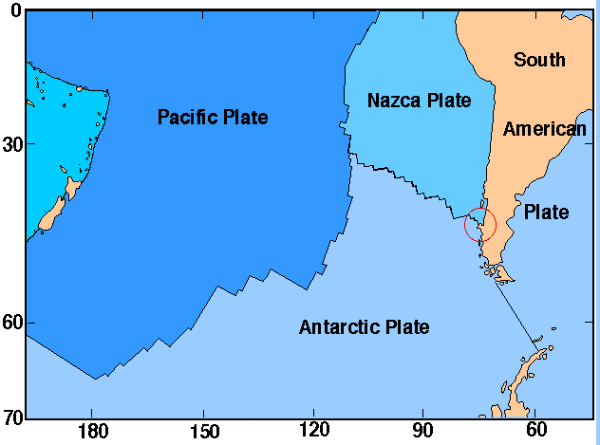
Tectonic sketch map of the South Pacific Ocean, showing the locations of the major plates and their boundaries. The active spreading ridge between the Antarctic plate and the Nazca plate is being subducted beneath the western edge of the South American plate at 46ø South latitude (Source: USGS/SOPAC)

Because ridge subduction represents a huge change in the thermal structure of the continental margin, it has lasting effects on the structure of the crust where it has taken place. These changes might influence such improtant modern phenomena as earthquake seismicity. If we can gain insights in to the geological and geophysical evolution of continental margins by studying active modern examples such as Southern Chile where spreading ridge subduction is taking place, we might be able to better understand the evolution of the San Andreas fault and other regions where similar events have occurred in the past. (USGS/SOPAC)

Epicenter location in Google Maps

Geography of Chile

Important / Destructive Earthquakes in Chile, 1570 – Present


Related posts:

  1. Magnitude 6.1 earthquake hit Atacama desert region in Northern Chile A strong earthquake of 6.1 grades affected some localities on the north of Chile and caused panic among the inhabitants. The local newspapers informed that a lot of people where in the shopping malls and escaped asap to open places, thinking that it was a stronger earthquake. The shallow magnitude 6.1 earthquake  occurred along the northern Chile coast at Atacama desert region at 22:23:09 UTC with epicenter 79 km (49 miles) NNW of Vallenar, Atacama,......
  2. Atacama Desert coated with record snowfall One of the driest places on the planet got a wintry blast this week. The Atacama Desert region in Chile was coated with its heaviest snow cover in nearly two decades, the BBC reported. An estimated 80 centimeters (31.5 inches) piled up in the normally arid region. A cold front moved through the region this week, bringing colder than usual weather, even though it’s the Southern Hemisphere winter, to Chile, Argentina and Uruguay. The temperature in Santiago, Chile, plunged to  minus......
  3. The Chilean caldera still emits a steady stream of ash The r in Chile continues to spew ash that is still disrupting travel as far as Australia and New Zealand this week. A new animation of satellite imagery just released from the NASA/NOAA GOES Project shows the ash spewing from the volcano. The animation begins on June 24 at 0039 UTC (June 23 8:39 p.m. EDT) and runs 22 seconds. In the animation, the ash plume originally appears very thin as it blows northward. As the......
  4. Puyehue Cordón Caulle volcano still smoking, but quietly For two and a half months Chile’s Puyehue Cordón Caulle Volcanic Complex has erupted nearly continuously. Since the violent initial stages of the eruption, that hurled pumice tens of kilometers from the eruption site, Puyehue Cordón Caulle has settled into a mild phase. Emissions of fine ash and volcanic gases are accompanied by volcanic tremor— “continuous, rhythmic ground shaking.” On the morning of August 14, 2011, the volcano emitted an ash plume that streamed east-northeast over Argentina, where it dispersed......
  5. Discovery of new species of seabird, the first in 89 years A new species of seabird has been hiding in plain sight in coastal Chile. The existence of the sparrow-sized black and white species of storm petrel was confirmed in February near the coastal community of Puerto Montt, Chile. This is the first new species of storm petrel discovered in 89 years, and the first new species of seabird discovered in 55 years. Storm-petrels are seabirds in the family Hydrobatidae, part of the order Procellariiformes. These......
  6. Chile’s volcanic devastating toll on environment Several Latin American countries in the path of volcanic ash unleashed from a Chilean Andean crater are facing critical shortages of water, agricultural collapse, disruptions in transportation and growing risks to human and animal health. Toxic ash clouds, seen to be dispersing toward Australia, have dumped the powdery substance across vast swathes of territory in Chile, Argentina, Brazil and Uruguay. The ski season in Patagonia also faced cancellations as volcanic ash affected airport operations at......
  7. Puyehue-Cordón Caulle Perhaps the greatest danger posed by the erupting Puyehue-Cordón Volcano Complex in Chile is the thick layer of ash being deposited east of the volcano. This image, taken on June 13, 2011, by the Moderate Resolution Imaging Spectroradiometer (MODIS) on the Terra satellite, shows ash on the ground and a large plume streaming east from the volcano. The pale tan coating of ash on the ground has been accumulating since June 4, when the eruption......
Tags: