Understanding the 6.9 Sikkim earthquake

TECTONIC SUMMARY A magnitude 6.9 earthquake hit Sikkim, India 12:40:48 UT (10:48 PM at epicenter). The depth of the hypocenter was at 20.7 km. The earthquake caused victims and huge damage in Sikkim (India), India and Nepal. It was also well felt in Bangladesh. The September 18, 2011 in Sikkim region, India earthquake occurred near the boundary between the India and Eurasia plates, in the mountainous region of northeast India near the Nepalese border. Initial...

TECTONIC SUMMARY

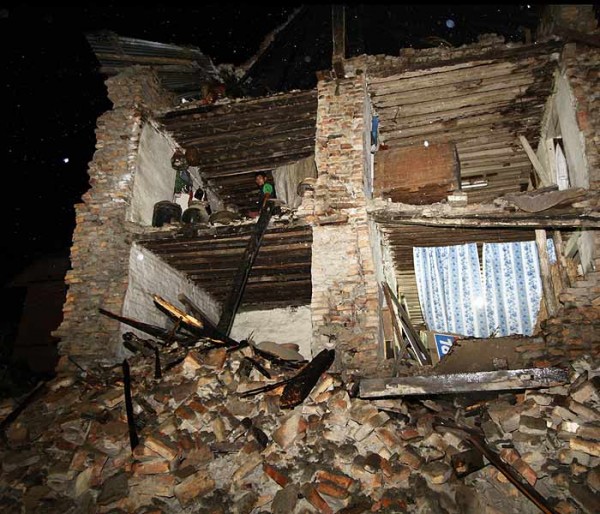
A magnitude 6.9 earthquake hit Sikkim, India 12:40:48 UT (10:48 PM at epicenter). The depth of the hypocenter was at 20.7 km. The earthquake caused victims and huge damage in Sikkim (India), India and Nepal. It was also well felt in Bangladesh.

The September 18, 2011 in Sikkim region, India earthquake occurred near the boundary between the India and Eurasia plates, in the mountainous region of northeast India near the Nepalese border. Initial analysis suggest the earthquake was complex, likely a result of two events occurring close together in time at depths of approximately 20 km beneath the Earth’s surface.

At the latitude of the September 18 earthquake, the India plate converges with Eurasia at a rate of approximately 46 mm/yr towards the north-northeast. The broad convergence between these two plates has resulted in the uplift of the Himalayas, the world’s tallest mountain range. The preliminary focal mechanism of the earthquake suggests strike slip faulting, and thus an intraplate source within the upper Eurasian plate or the underlying India plate, rather than occurring on the thrust interface plate boundary between the two.

This region has experienced relatively moderate seismicity in the past, with 18 earthquakes of M 5 or greater over the past 35 years within 100 km of the epicenter of the September 18 event. The largest of these was a M 6.1 earthquake in November of 1980, 75 km to the southeast. (USGS)
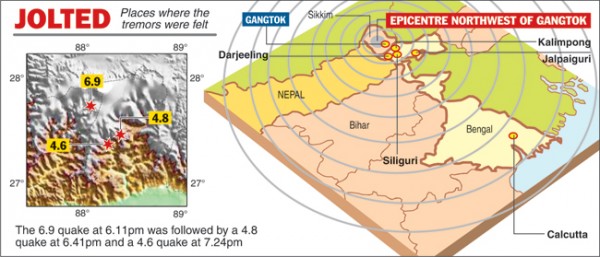
The collision with the Eurasian Plate along the boundary between India and Nepal formed the orogenic belt that created the Tibetan Plateau and the Himalaya Mountains, as sediment bunched up like earth before a plow.

The Indian Plate is currently moving northeast at 5 cm/yr (2 in/yr), while the Eurasian Plate is moving north at only 2 cm/yr (0.8 in/yr). This is causing the Eurasian Plate to deform, and the India Plate to compress at a rate of 4 mm/yr (0.15 in/yr).
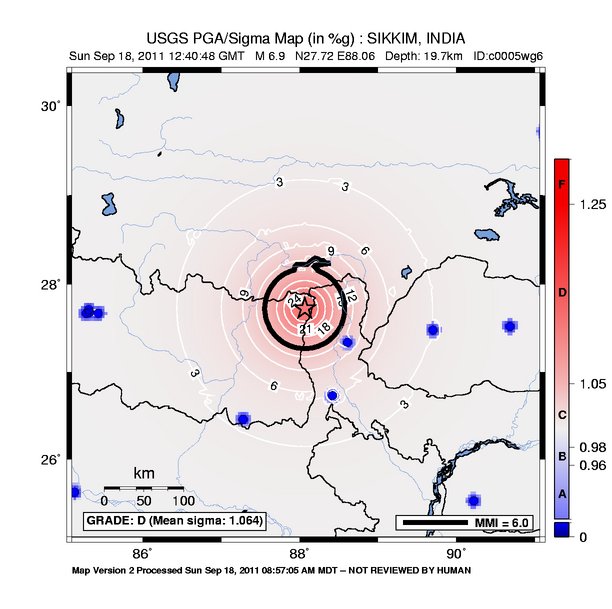
The ministry [of earth sciences] has set up at least 16 earthquake monitoring laboratories in Sikkim and North Bengal, which are monitored by faculty and students of the [geophysics department of IIT Kharagpur].

The data recorded in these laboratories has been able to pinpoint that the epicentre lay 35 kilometres beneath the earth’s surface and the quake could be categorized as one of the strike-slip movement type that came with a single big jerk and three smaller aftershocks. The ground just above the epicentre felt a jerk of .45g. The report says that Gezing, another place in Sikkim, felt a tremor of the magnitude of .3g, Lingja followed next with .28g and Mangan .24g. (TOI)

The epicentre of the tremor lies just below the Kanchanjungha liniament or hidden fault, making it extremely earthquake prone,” said Shankar Nath, head of the geophysics department who is also the lead scientist of the project.
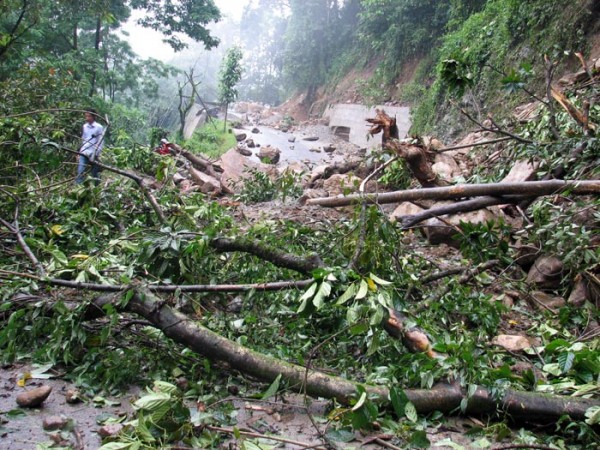
 

Earthquake hazard in NorthEast India – A seismic microzonation approach with typical case studies from Sikkim Himalaya and Guwahati City (IAS-AC)

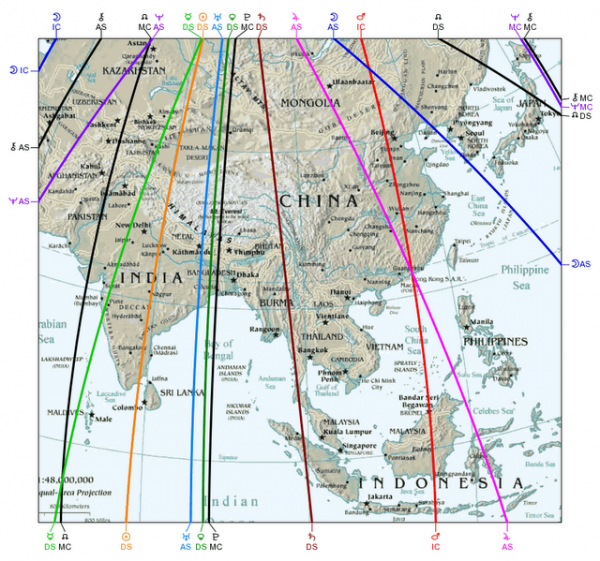
The AstroCartoGraphy map for the earthquake shows Venus, Uranus, and Pluto all angular at the epicenter. Venus has been translating the epic Uranus-Pluto square of revolution and evolution, and these are sharply focused in the earthquake chart. Uranus is rising, Venus is setting, and Pluto is culminating. These simultaneous angularities are know as parans. Pluto just stationed-direct on Sept. 16 so is virtually stationary now, and thus it’s power is concentrated.(StellarInsight)

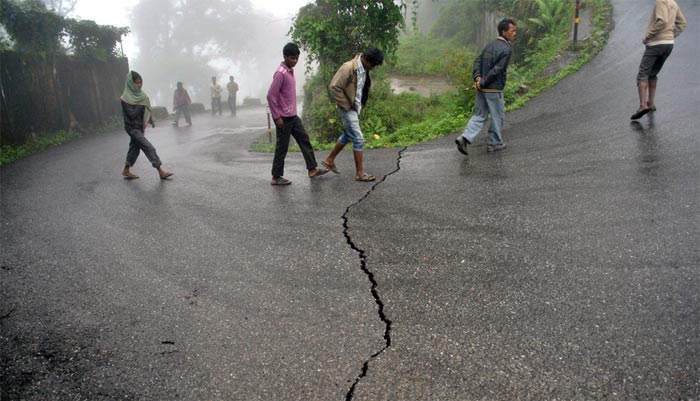
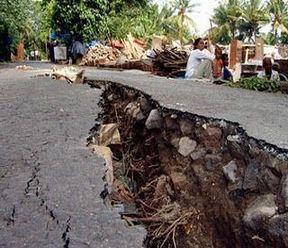
Sunday Earthquake that reached the comparatively safer seismic zones of South Chotanagpur plateau, besides generating cracks in buildings and roads in different parts of the state, exposed the lack of preparedness of the state administration in handling such eventualities. Once the panic of tremors started subsiding by late evening, rumour mills started working and hundreds of people came out in the open late in night after some anonymous SMSes and phone calls circulated in capital predicting another shock at 11.30 PM. (TimesOfIndia)

Rescue teams backed by army sappers using explosives tried to force their way on Tuesday to the remote epicentre of a powerful Himalayan earthquake that killed 67 people in India, Nepal and Tibet. Before the grim search for more victims can even begin, the main challenge is to reach the isolated, mountainous impact zone on the border between Sikkim and Nepal after Sunday’s 6.8 magnitude quake. (HindustanTimes)


Related posts:

  1. Magnitude 6.9 – Sikkim, India A magnitude 6.9 earthquake hit India 12:40:48 UT (10:48 PM at epicenter)  68 km (42 miles) NW of Gangtok, Sikkim, India, 119 km (73 miles) NNW of Shiliguri, West Bengal, India, 272 km (169 miles) E of KATHMANDU, Nepal (27.723°N, 88.064°E). The depth of the hypocenter was at 19.7 km (12.2 miles). The quake comes just days after an earthquake of 4.2 magnitude hit Haryana’s Sonepat district, sending tremors in New Delhi. The earthquake occurred on a strike-slip fault from the moment tensor solution. Spokesperson at Metropolitan Police......
  2. Are we on the verge of an event in the South Pacific? We’ve seen a staggering number of signs in the last few days indicating major change may be unfolding. The Indo-Australian Plate is a major tectonic plate that includes the continent of Australia and surrounding ocean, and extends northwest to include the Indian subcontinent and adjacent waters. Recent studies suggest that the Indo-Australian Plate may be in the process of breaking up into two separate plates due primarily to stresses induced by the collision of the Indo-Australian Plate......
  3. Strong 6.9 earthquake hit Solomon islands Strong earthquake magnitude 6,9 hit 76 km (47 miles) west of Kira Kira near San Cristobal at Solomon island (10.349°S, 161.233°E) Saturday morning April 23rd at 04:17 UTC at depht of 81,6km. Residents on the mainland said they felt a sharp jolt but emergency services said there was no immediate evidence of damage although reports were still being sought from outlying islands. The Solomon Islands lie in the “Pacific Ring of fire“, a highly active earthquake......
  4. Europe is about to move below Africa We may be seeing the start of a new subduction zone. The Eurasian plate is 85% land mass with a very undefined plate boundary on its southern border connecting to the African, Indian and Australian plates. The continents are converging; and for many millions of years, the northern edge of the African tectonic plate has descended under Europe. Geologic features in the present-day Mediterranean essentially result from two major processes: the tectonic displacement caused by......
  5. Lake Baikal: the mysterious rift of fire at 900 fanthoms? Lake Baikal is not only the deepest lake in the world (1,637 meters) — it is also the oldest freshwater lake. According to scientists, the lake is more than 25 million years old, and holds about 20% of the world’s surface freshwater. The world’s largest fresh water lake is mysteriously warming for unknown reasons and Dr. Lyubov, a Russian scientist, believes she knows why – climate change. Lyubov believes one of the world’s oldest bodies......
  6. Deep seafloor could help scientists predict earthquakes Seismic monitoring and centuries of experience have given humankind a pretty good idea of what areas are prone to the devastation of earthquakes and tsunamis. But to truly prepare for huge temblors and accompanying tsunamis like the one that ravaged Japan in March, we need to take a closer look at the deep seafloor, according to one geophysicist. “Essentially, what we need to start being able to do is identify exactly how the offshore environment......
  7. Iceland’s Grímsvötn volcano erupted, it may trigger flooding Iceland’s most active volcano, Grimsvotn, has started erupting. The volcano, which lies under the Vatnajokull glacier in south-east Iceland, last erupted in 2004. In 2010, plumes of ash from Iceland’s Eyjafjallajokull volcano caused weeks of air travel chaos across Europe. Scientists say the latest eruption is unlikely to cause similar problems, although it may trigger localised flooding. Volcanic eruptions are common in Iceland, which lies along the Mid-Atlantic Ridge that divides the Eurasian and North American continental plates.......