
NASA conference about asteroid 2005 YU55 close flyby + Live stream!
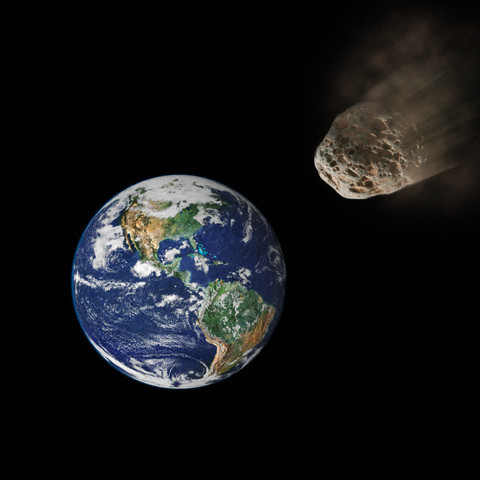
NASA scientists will have a unique observing opportunity with asteroid 2005 YU55, as the space rock “safely flies past Earth” at a distance slightly closer than the moon on Nov. 8, 2011.
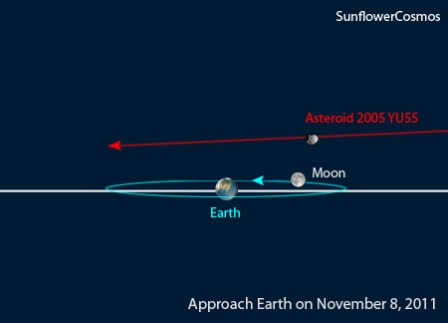
At the point of closest approach, the asteroid will be no closer than 201,700 miles (324,600 kilometers). The gravitational influence of the asteroid will have no detectable effect on anything here on Earth, including our planet’s tides or tectonic plates. Although 2005 YU55 is in an orbit that regularly brings it to the vicinity of Earth, the 2011 encounter with Earth is the closest this space rock has come for at least the last 200 years.
During the close flyby, scientists will use the massive 70-meter Deep Space Network antenna to study the asteroid. The 70-meter (230-foot) diameter antenna is the largest, and therefore most sensitive, DSN antenna, and is capabile of tracking a spacecraft travelling more than 16 billion kilometers (10 billion miles) from Earth.
A live broadcast and chat from NASA’s Jet Propulsion Laboratory, Pasadena, Calif., will allow viewers to ask questions of scientists with NASA’s Near-Earth Object Program Office about asteroid YU55, and find out how NASA discovers, tracks and characterizes asteroids and comets.
Participants include:
— Don Yeomans, manager, NASA’s Near-Earth Object Office at JPL
— Marina Brozovic, scientist, NASA’s Near-Earth Object Office at JPL

Tracking of the aircraft carrier-sized asteroid will begin at 9:30 a.m. local time (PDT) on Nov. 4, using the massive 70-meter (230-foot) Deep Space Network antenna, and last for about two hours. The asteroid will continue to be tracked by Goldstone for at least four hours each day from Nov. 6 through Nov. 10. Radar observations from the Arecibo Planetary Radar Facility in Puerto Rico will begin on Nov. 8, the same day the asteroid will make its closest approach to Earth at 3:28 p.m. PST.
During tracking, scientists will use the Goldstone and Arecibo antennas to bounce radio waves off the space rock. Radar echoes returned from 2005 YU55 will be collected and analyzed. NASA scientists hope to obtain images of the asteroid from Goldstone as fine as about 7 feet (2 meters) per pixel. This should reveal a wealth of detail about the asteroid’s surface features, shape, dimensions and other physical properties.
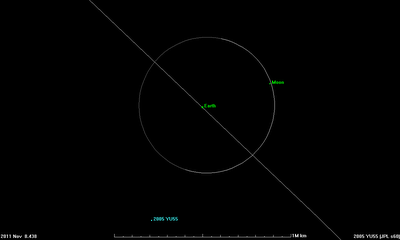
2005 YU55 Goldstone Radar Observations Planning
Arecibo radar observations of asteroid 2005 YU55 made in 2010 show it to be approximately spherical in shape. It is slowly spinning, with a rotation period of about 18 hours. The asteroid’s surface is darker than charcoal at optical wavelengths. Amateur astronomers who want to get a glimpse at YU55 will need a telescope with an aperture of 6 inches (15 centimeters) or larger.
The last time a space rock as big came as close to Earth was in 1976, although astronomers did not know about the flyby at the time. The next known approach of an asteroid this large will be in 2028. NASA detects, tracks and characterizes asteroids and comets passing close to Earth using both ground- and space-based telescopes. The Near-Earth Object Observations Program, commonly called “Spaceguard,” discovers these objects, characterizes a subset of them, and plots their orbits to determine if any could be potentially hazardous to our planet.
Asteroid Radar Research (ECHO)
JPL Small-Body Database Browser (2005 YU55)
This rare flyby of the asteroid–which is known as 2005 YU55–will likely draw significant public interest because of the asteroid’s large size of about 396 meters (1,300 feet) in diameter, the nature of its close encounter with Earth and the public’s fascination with near-Earth objects.
The chat is sponsored by ScienceNOW, the daily news site of the journal Science. To participate, go to ScienceNow’s website on November 3 at 3 p.m. EDT and submit questions to:
- Scott Fisher: A program director in the Division of Astronomical Sciences at the National Science Foundation and a staff scientist at the Gemini Observatory–a large international observatory with eight-meter telescopes located in Hawaii and Chile–where he researches planet formation.
- Donald K. Yeomans: A scientific investigator on NASA’s Deep Impact mission that successfully impacted comet Tempel 1 in July 2005, and a senior research scientist at the Jet Propulsion Laboratory, where he contributes to predictions of future close Earth approaches and impacts by comets and asteroids.
The November 3 chat about asteroid 2005 YU55 and other near-Earth objects provides an ideal opportunity to ask experts about these and other topics:
- What is currently known about the 2005 YU55’s size, shape, orbit and origins?
- What are the real dangers potentially posed by asteroids and comets vs. threats hyped by doomsayers?
- What is the likelihood that 2005 YU55 will ever crash into the Earth?
- When and where is the best place to view 2005 YU55?
- How are scientists currently tracking comets and asteroids that may impact the Earth?
- What types of additional information are scientists likely to learn about 2005 YU55 and asteroids in general via radar, visual and infrared monitoring of the asteroid during its close approach to Earth?
The live online chat on 2055 YU55 is part of the journal Science’sweekly series of chats on the hottest topics in science held every Thursday at 3 p.m. EDT. (NSF)
UPDATE:
Recorded live on November 1, 2011 10:29 PM CET

The time will come soon when all on Earth will look to the Heavens above.
IMPORTANT NOTICE TO ALL THAT LIVE BY THE SEA OR OCEAN SHORE AT 1 FOOT TO 50 FEET ABOVE SEA LEVEL. Or with in ten miles of the coast. World Wide.
This will be a very close call i pray it is only that. Discovered on December 28, 2005 by Robert McMillan of the Spacewatch Program A potentially hazardous Asteroid known as 2005 YU55.
This Asteroid some what Large 400 meter-sized type – C, will pass by the Earth right between our moon and Earth. On November 8, 2011.
The people on Earth have not seen a Asteroid of this size in advance. One this big Has not impacted Earth in over at least 4 thousand years.
Most Objects that have a diameters over 45 meters or 147.637 ft strike the Earth approximately once every thousand years or so. Lying flat everything for hundreds of miles.
Like the TUNGUSKA 1908 SIBERIA, RUSSIA CRASH OR Tunguska Explosion. This one did not even hit the Earth with its full Impact, it burst high in the air above the ground plowing it apart into many smaller parts. Making thousands of very deep holes in the Russian forests. Many of them in dense forest far from any roads or towns.
One 400 Meters 1,312.3 ft in diameter like this one YU55 weighing millions of tons would if impacted Earth on land would darken all of the Earth not for just days but much longer.
It would change the weather not seen on Earth in over thousands of years a massive climate change to say the least.
Asteroids in our Asteroid Belt that is between the orbits of Jupiter and Mars do have collisions and some do turn into meteoroids many in the past thousands of years have come into the Earth’s Atmosphere. Many of thousands of them make it into Meteorites the signs are all over the Earth, craters of all sizes.
Now Earth going through a Debris Field or Tail of a Comet or large Asteroid at almost the same time as Asteroid YU55 near Earth Miss? Debris fields some times are very Large to say the least.
The World and NASA will watch Outer Space very closely the next 30 days.
Most likely more Earthquakes and the Oceans Tide will be strongly affected just from a near miss. The Gravitational Effects from outer space will most likely effect Earth for days.
Let us all pray
this is just a near Earth miss or NEO (Near Earth Object) or Near Earth Orbit.
READ THE BIBLE
Judgment Day will come soon enough.
Please Look at this site it is NASA’s Near Earth Object Program.
neo.jpl.nasa.gov/ca/
UP COMING CLOSE APPROACHES TO EARTH
Then go to
(2005 YU55) NOV 8, 2011
(2005 XB1) NOV 8, 2011
(2011 TP6) NOV 2011
(2000 YA) DEC 26, 2011
Add a asteroid about a mile wide into this Equation and ???
Object ( 20011LC19 ) it to will be going by Earth around Oct 28, 2011 tru
Nov 4, 2011. It is 1.2km or 3,937Ft wide.
May The Lord GOD our Father in Heaven Watch over and Guide you.
GOD Bless
Read the Bible
John 8:12-31
Mark 10:17-30
The Lord’s Little Helper
Paul Felix Schott
lame duck for earth……huh
The giant asteroid “Apophis” has a 1 in 250,000 chance of striking Earth in 2036. Many more smaller asteroids frequently threaten Earth. NASA reported that on Feb. 4th, asteroid 2011 CQ1 zipped past Earth at a record close distance: a mere 3,400 miles away. It was discovered by scientists only 14 hours before the rock approached Earth!
Asteroid 2011 MD was discovered just four days prior to its final approach on June 22th by the Lincoln Near Earth Asteroid Research discovery team in New Mexico. A small asteroid, estimated between 16 and 65 feet
in diameter, whipped past Earth on June 27th – missing by a scant 7,600 miles. According to NASA, an object the size of asteroid 2011 MD is expected to come this close to Earth about every six years on average, and when 2011 MD makes another pass in 2022, an impact with Earth is possible.
A larger, 1,300-foot asteroid, asteroid 2005 YU55, is expected to flash past Earth on Nov. 8, 2011.
Every 100 million years or so an asteroid six-miles wide – one that might create massive craters and tsunamis, threaten our planet’s atmosphere, or even cause mass extinction – will strike the Earth if its orbit is not
readjusted. How long has it been since the dinosaurs were wiped, huh?
small margin of error does not mean no possibility question how do you measure in your observations the influence of gravity and gravity and magntosphere influence of earth and moon on this or other asteroids
2011 UX255,0.4 LD,15 m just passed oct 28 even closer … everyday asteroids pass earth…and from thousand of them,most not even visible till the last second..so we’re sitting ducks anyway you put it …